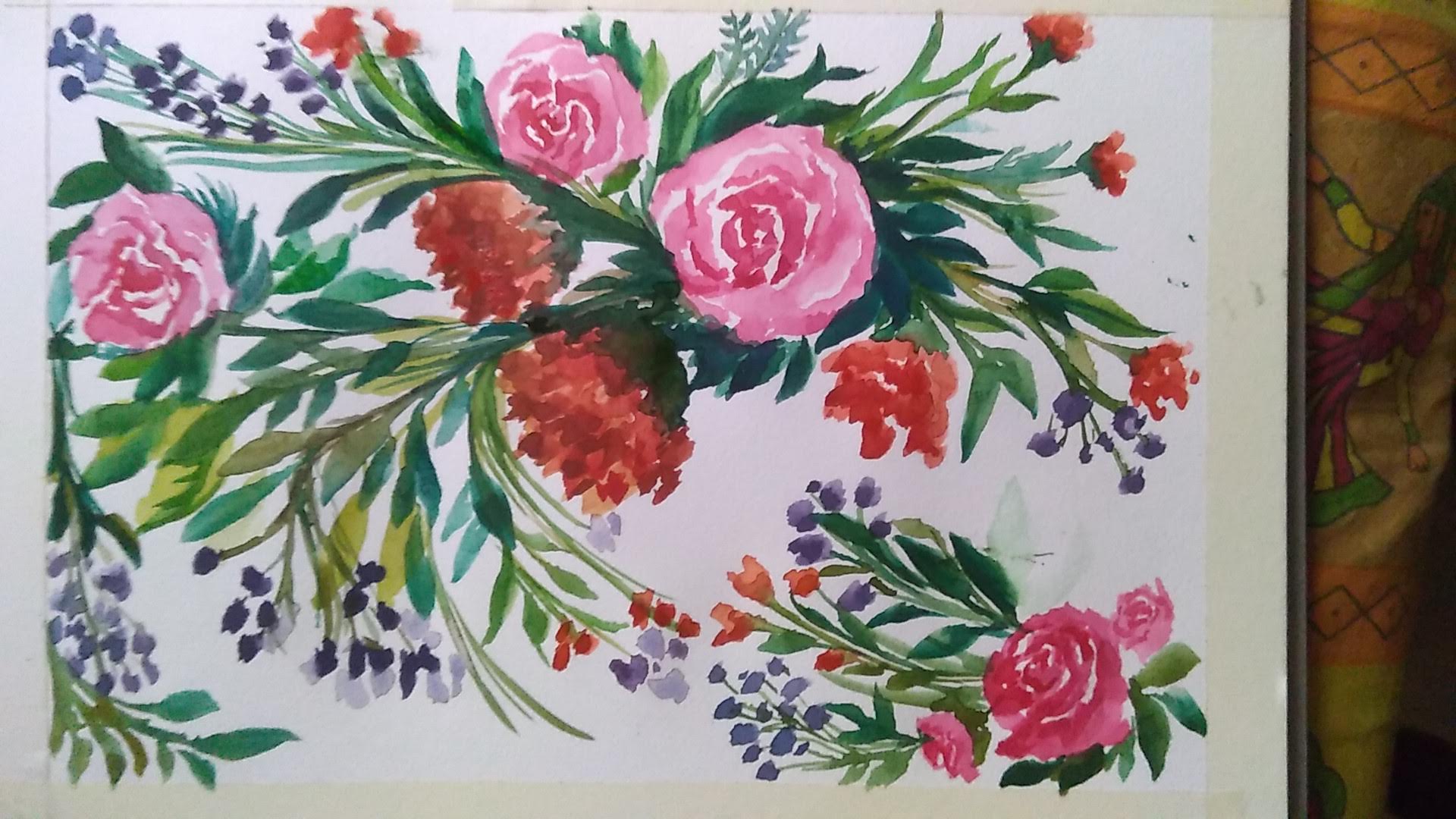
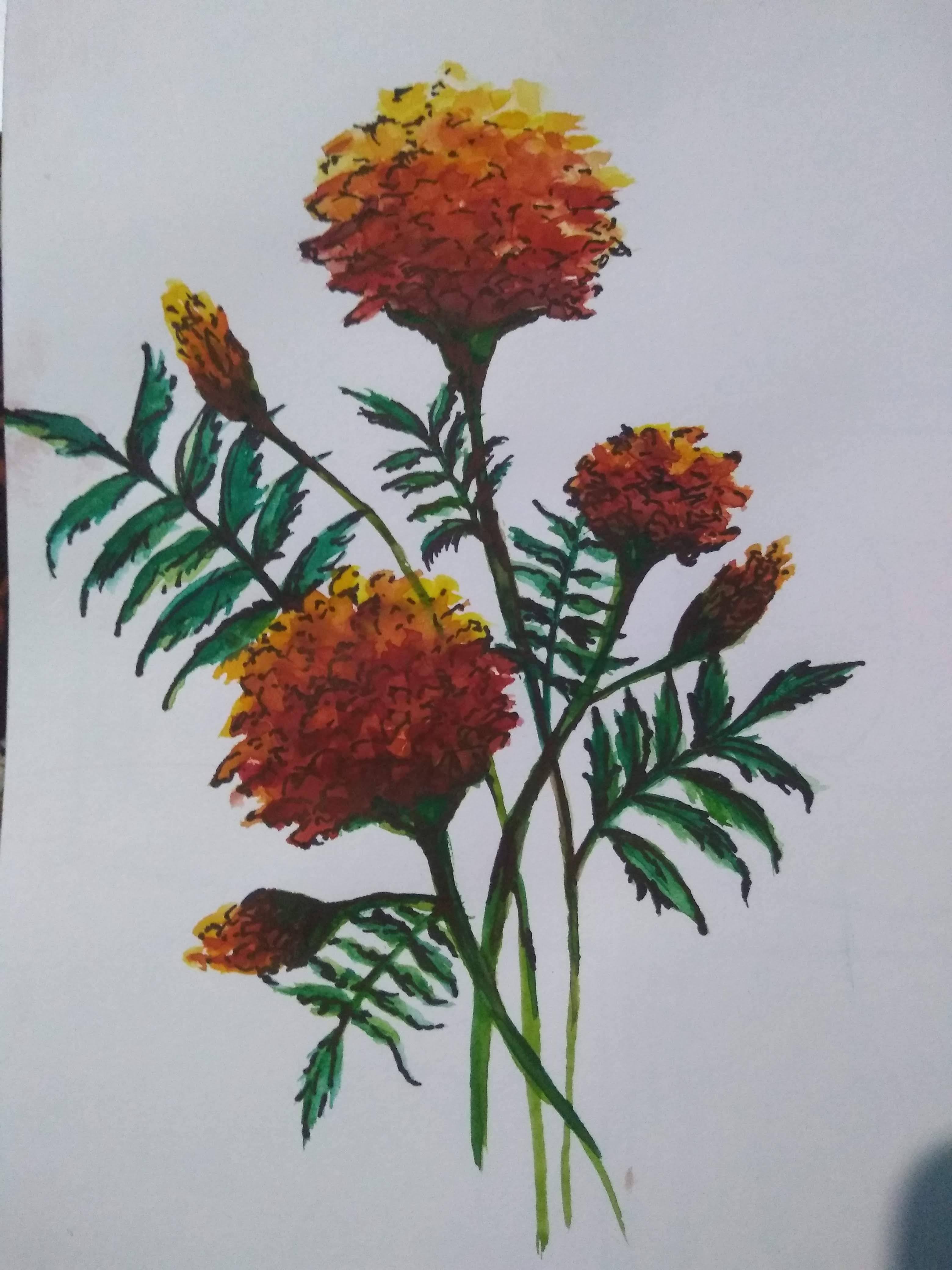
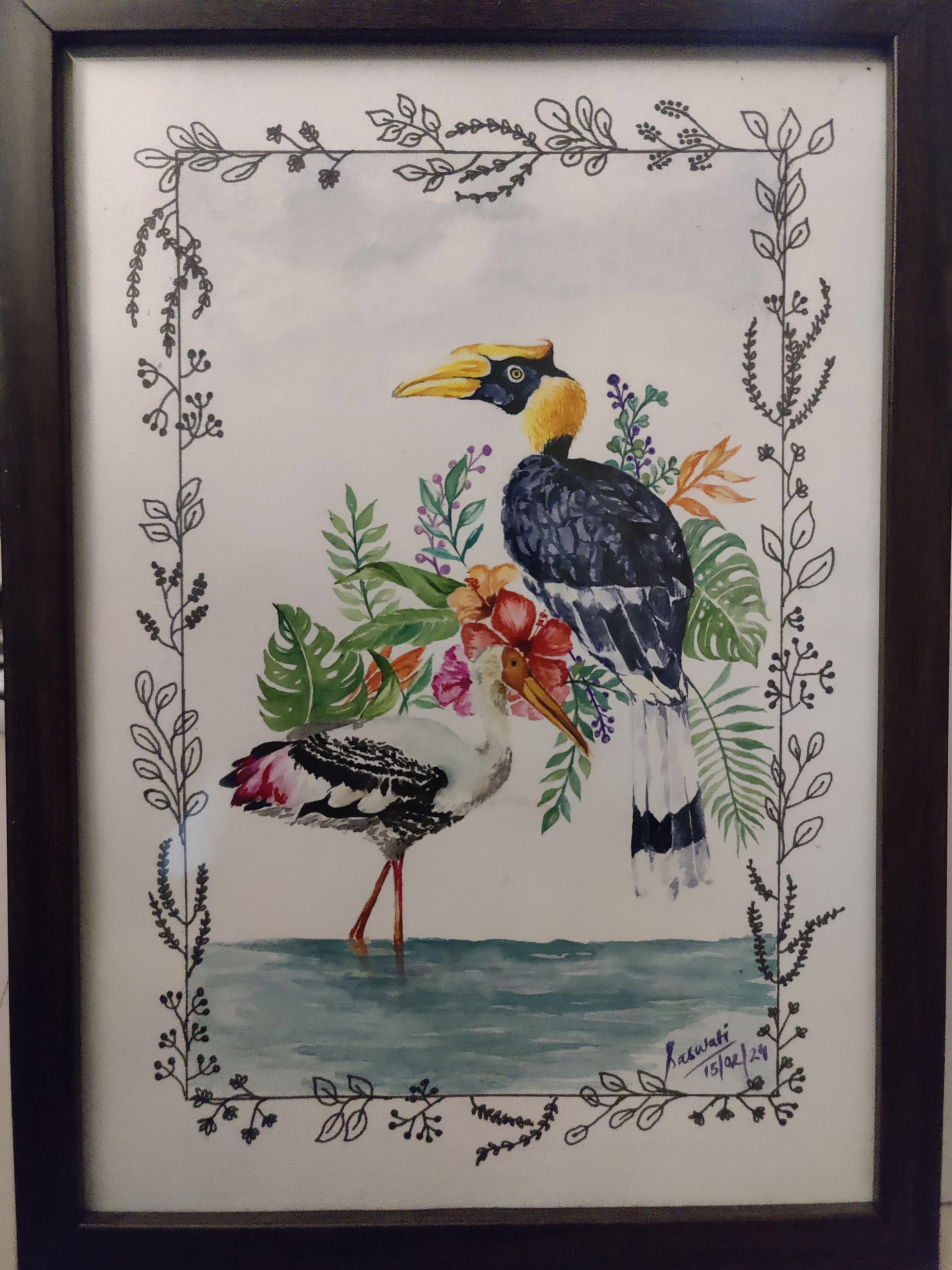
Hornbill and Painted Stork — watercolor and ink, 2024
It started at a lake in Bangalore.
I used to go cycling on weekends to the lakes around the city — Hebbal, Ulsoor, Madiwala. Bangalore has these pockets of water that feel improbable in the middle of all the traffic and construction, and if you go early enough, they're quiet. One morning, I stopped at the edge of a lake and watched a bird I'd never noticed before. It was tall, mostly white, with these striking pink flight feathers and a long curved bill. Beautiful. Unmistakable. And I had absolutely no idea what it was.
That bothered me. I'd been coming to this lake for months. How many times had I seen this bird — or birds like it — without actually seeing them? I was sure it had a name. I was sure I should be able to recognize it the next time I came back. But I couldn't. I'd been looking without ever really looking.
The Book
A few weeks later, I was at my friend Hussain's house and noticed a thick field guide on his shelf: Birds of the Indian Subcontinent. I borrowed it. It's one of those books that changes the resolution of your world — suddenly every bird isn't just “a bird.” It's a Painted Stork, or a White-throated Kingfisher, or an Asian Koel whose call you've been hearing your whole life without ever connecting it to the black bird sitting on the telephone wire.
I started identifying the lakes systematically. Weekend rides became survey routes. I'd stop at a lake, sit for twenty minutes, and just watch. At first I was terrible at it — I'd misidentify species, mix up juveniles and adults, mistake a cormorant for a darter. But slowly, something shifted.
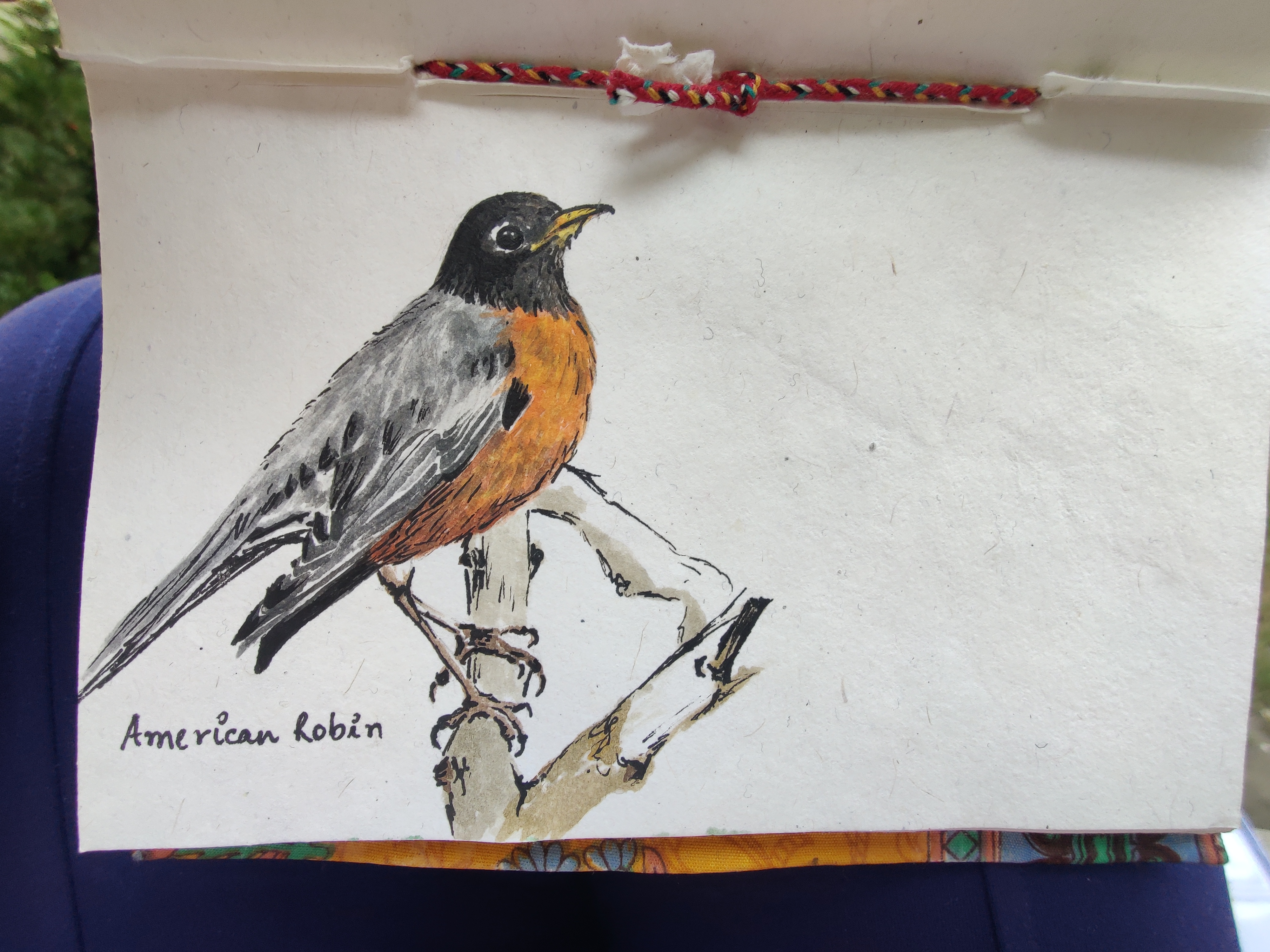
American Robin — watercolor field sketch. The practice continues across continents.
The Third Eye
The shift was extreme and I noticed it almost overnight. Once I knew the call of a Coppersmith Barbet — that metronomic tuk-tuk-tuk — I started hearing it everywhere. Not just at the lake. In my neighborhood. Walking to work. Sitting on a balcony in a completely different city. The bird had always been there, calling. I just hadn't had the vocabulary to hear it.
It was like unlocking a third eye. The world didn't change — I changed. Suddenly the ambient noise of a city wasn't just noise. It was layered with information. A Black Kite circling overhead. A Rose-ringed Parakeet streaking between buildings. A Common Myna hopping along a wall that I'd walked past a thousand times without seeing.
And it made me think about something deeper: was I really in tune with what I was hearing before? Before I knew the names, before I knew what to listen for — was I actually experiencing the world around me, or was I just passing through it?
There's a difference between hearing and listening, between looking and seeing. The shift from one to the other is not gradual. It's a door that opens, and once it opens, you can't close it.
Consciousness and Shared Experience
Bird watching made me think differently about consciousness. When you sit at the edge of a lake at dawn and watch a heron standing motionless in the shallows — genuinely motionless, for ten minutes, fifteen — you start to wonder what it's like to be that creature. What is its experience of waiting? Does it experience anticipation? Is its stillness a strategy or a state of being?
You can't answer these questions. But the act of asking them changes you. It forces a kind of humility — a recognition that you are sharing a world with billions of other minds, most of which you will never understand but all of which are real. The bird doesn't care that you're watching. It was there before you arrived and will be there after you leave. You are the visitor.
There's something grounding about that. In a world that constantly tells you to optimize, to build, to ship — being in the presence of a creature that is simply being is a corrective. Not everything needs to be productive. Sometimes the most important thing you can do is sit still and pay attention to what's already here.
What I Want Others to Experience
I'm not writing this to make a business case for bird watching (though I could). I'm writing it because the shift I experienced — from not-seeing to seeing — is one of the most profound things that has happened to me, and I want other people to have it.
It doesn't have to be birds. It can be trees, or clouds, or the way light falls on a building at a particular hour. The point is the practice: choosing to look closely at something that doesn't demand your attention, that won't notify you, that exists whether or not you engage with it. In a world designed to capture your focus, choosing where to place your attention is a radical act.
I still paint the birds I see. I still stop at lakes when I can. And every time I hear a call I recognize — in a new city, on a different continent — I feel the same small thrill. Not the thrill of knowledge, exactly. The thrill of connection. Of being tuned in to something that was always there, waiting for me to notice.
The birds were always there. The question was whether I was paying attention.